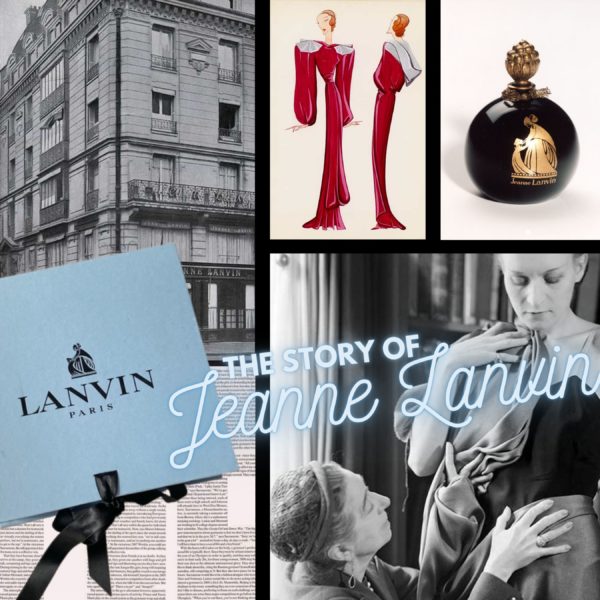
The eldest of a modest family of eleven children, Jeanne Lanvin was born in Paris on January 1, 1867. From an early age, her independence and strength of character foretold Jeanne’s extraordinary fate. At the age of thirteen, Jeanne earned her first wages working for a milliner on Rue du Faubourg Saint-Honoré. In charge of delivering hats all over Paris by omnibus, she found a clever way to save the cost of a bus ticket: she followed the vehicle on foot. Nicknamed the «Little Omnibus», Jeanne had already gotten herself noticed and quickly worked her way up the ladder.
A hard worker, Jeanne Lanvin began her milliner’s apprenticeship a few years later and proved to be quite creative. The hats created by «Mademoiselle Jeanne» were met with great success, and Jeanne started dreaming of opening her own shop. The dream would soon become a reality for the then 22-year-old milliner. Through her many sacrifices and persistence, she managed to get her creations, labeled «Lanvin (Mademoiselle Jeanne) Modes», worn by the most fashionable Parisians.
 Portrait of Jeanne Lanvin, 1934 © Studio Harcourt / Patrimoine Lanvin
MOTHER AND DAUGHTER
On August 31,1897, Jeanne Lanvin gave birth to Marguerite: her only child, her greatest love, and her muse. From their close bond was born one of the most famous French fashion houses. Nothing was too beautiful for Marguerite. The little girl became the first source of inspiration for Jeanne Lanvin, who designed an incredibly sophisticated wardrobe for her from a very early age. The mother and daughter never left each other’s side. It wasn’t uncommon to catch sight of Marguerite meandering around the hat shelves in the store, where she was often complimented on her elegant outfits. A new opportunity then presented itself to Jeanne Lanvin, who decided to delve into children’s clothing.
This extraordinary mother-daughter relationship is deeply connected to the brand’s history: it was out of her love for Marguerite that Jeanne Lanvin began designing dresses. It was also for her daughter, who by then had become Countess Marie-Blanche de Polignac, that Jeanne launched the legendary perfume Arpège in 1927, as a birthday present. Through this extraordinary bond of maternal love, the brand’s iconic logo was born: a drawing of a woman and her child, imagined by the Art Deco illustrator Paul Iribe.
 Marie-Blanche de Polignac, circa 1930 © Roger Schall/ Patrimoine Lanvin
A STEP AHEAD
A true visionary, Jeanne Lanvin captured the spirit of the times throughout her career in order to bring her fashion house to heights of elegance and modernity. The designer was a pioneer in many fields. It was important for her to forge ahead and never fall behind. A jack of all trades, Jeanne Lanvin developed the brand’s business by regularly opening new departments in order to meet the needs of an evolving society.
Hats, children’s clothing, young ladies’ and women’s collections, furs, lingerie, wedding gowns, sports attire, men’s collections, perfumes, and even interior design: through her audacity, Jeanne Lanvin gradually built an empire and heralded a lifestyle revolution. Her career boasts a long list of firsts: Jeanne Lanvin was the first designer to launch a children’s fashion line in 1908; the first to offer a made-to-measure men’s collection in 1926; and even the first to create a mixed eau de toilette in 1933. At its peak, Lanvin had nearly 1,200 employees, many stores, and several branches throughout the world, all thanks to the vision of an exceptional woman.
 Modèle Sport, Hiver 1928. Gouache Drawing © Patrimoine Lanvin
TRAVEL JOURNALS
The success of Lanvin was unmistakably due to the curiosity, inventiveness, and creative energy of its founder. With each new collection, Jeanne Lanvin sought to reinvent herself and drew inspiration from traveling, the artists of her time, and everything around her. When she wasn’t working on her next collection, Jeanne Lanvin would frequently travel, taking the time to jot down her experiences and inspirations. Her travel journals were never far from her when she was working, carefully stored away in her office.
In addition to her memories, Jeanne Lanvin would write about objects she had found, fabric samples, or the traditional clothing of the countries she or her close friends and family would visit: Indian saris, Chinese attire, toreador outfits, or ethnic embroideries and materials.
 Egypt, circa 1930 – © DR / Patrimoine Lanvin.
AN ARTISTIC SENSIBILITY
Although she mostly kept to herself, Jeanne Lanvin’s artistic sensibility and creative spirit opened the doors very early on to the most avant-garde artistic circles of her time. The designer would frequently socialize with painters from the Nabis movement, in particular Édouard Vuillard, with whom she shared an obsession with color.
Jeanne Lanvin was also a collector, amassing works by Renoir, Degas, Fantin-Latour, Fragonard, and many others. She was highly influenced by the use of light in Impressionist paintings as well as the symbolic works of Odilon Redon. These artistic affinities could often be seen in the brand’s collections. Jeanne Lanvin’s passion for color even led her to open her own dye factory in 1923.
 Jeanne Lanvin at a fitting with Yvonne Printemps, circa 1936 – © DR / Patrimoine Lanvin.
THE LANVIN STYLE
Jeanne Lanvin had many inspirations, but elegance, femininity, and modernity were the designer’s key words. In the 1920s, Lanvin stood out for its use of bold colors combined with innovative decorative techniques. Ribbons, embroideries, pearls, and precious details adorned dresses without ever compromising the ateliers’ cutting work and exceptional construction.
The use of black and white was frequently incorporated with the brand’s iconic colors, such as the Lanvin blue. This combination, sometimes interspersed with touches of silver, represented the peak of chic in the mid-1920s. It was the result of geometric research inspired by the Art Deco movement, which was then at the height of its influence.
 Embroideries and beading created in the Lanvin ateliers between 1925 and 1935 – © Patrimoine Lanvin.
MADAME LANVIN
The success of Jeanne Lanvin’s fashion house lay in her long years of persistent work. Reserved and meticulous, her unique personality made her stand out from her contemporaries.
«Madame,» as her staff called her, was a demanding boss who, nevertheless, put great trust in the talented individuals surrounding her. Jeanne Lanvin was self-taught and did not draw. She worked a lot with the materials and exchanged her ideas directly with her head seamstresses, who were responsible for creating the models. Refusing to participate in most social events, the designer evolved within restricted and intimate circles of artists, writers, and musicians. It was very rare to see her at a ball or at the Longchamp races, and if by chance you ran into her there, it was because she came to observe the elegant Parisians in order to better anticipate their future desires.
On July 6, 1946, Jeanne Lanvin passed away peacefully at the age of 79. «Madame» Jeanne—the milliner, the designer, the decorator, the perfume manufacturer—left behind an empire in her wake.
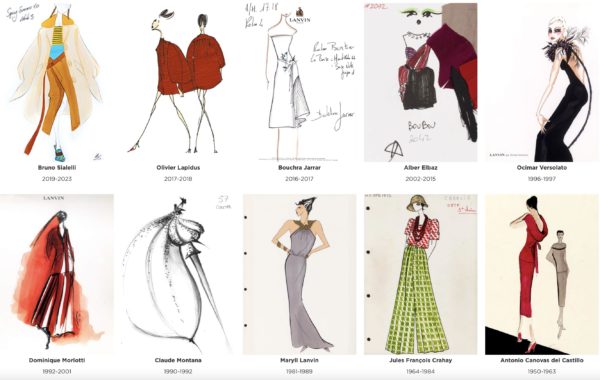
After Jeanne Lanvin passed away, her daughter Marie-Blanche became president of the company and continued to design collections until 1950. Several designers succeeded her with the ambition of keeping the brand’s expertise, state of mind, and excellence intact.
Since 2018, it has been a subsidiary of Shanghai-based Lanvin Group, originally named Fosun Fashion Group. Stay tuned for the next post, in which I will tell you how Lanvin does new-tailoring today under the creative vision of Bruno Sialelli, a 31-year-old French designer!
LoL, Sandra
 Jeanne Lanvin and a mannequin, 1935 – © New York Times/Rea
Photos: © LANVIN
DISCLOSURE: We may earn commission from links on this page, but I only recommend products I love. Promise!